Hey guys, if you’ve ever worked in mining, bulk material handling, or any industry where you move stuff like coal, grain, or ore, you know how important conveyor belts are. But there’s a big thing you might not hear talked about enough: anti-static pipe conveyor belts. Let me break this down like I’m chatting with you, not writing a textbook, ‘cause I know most of us don’t want to sift through jargon. Pipe Conveyor Belt
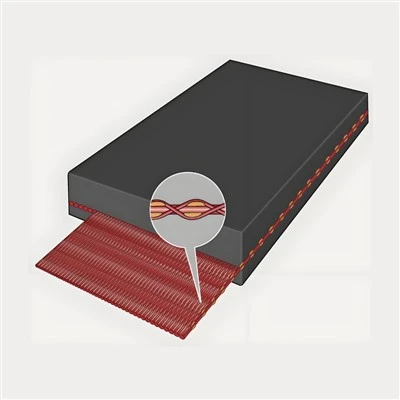
First, let’s get what a pipe conveyor belt even is, quick. Unlike a regular flat conveyor that’s just a flat strip carrying stuff, a pipe belt wraps the material into a tight tube as it moves. That means less spillage, no dust flying everywhere, and you can even run it around corners without weird side issues. Cool, right? But when you’re moving dry, fine materials at high speeds, friction happens—between the belt, the material, even the air. That friction builds up static electricity. Static sparks, especially near flammable materials like coal dust, grain dust, or chemical powders? That’s a disaster waiting to happen. Enter the anti-static pipe conveyor belt.
So what’s the anti-static property here, exactly? It’s not magic, it’s a special mix of materials in the belt’s rubber (or whatever compound we use) that stops static from building up and discharging. Regular conveyor belts are insulators—they don’t let electricity flow through them. That’s great for some jobs, but bad for static. Anti-static belts have conductive agents mixed in, like carbon black (not just any carbon, special grades), zinc oxide, or even some specialized polymers. Those agents create a tiny path for electrons to flow, so any static that builds up doesn’t get trapped. Instead, it bleeds off into the ground, or into special grounding systems you install with the belt.
Wait, let’s test this with something you might relate to. Ever rubbed your socks on carpet and zapped yourself on a doorknob? That’s static from insulators. If your socks were made of a conductive material, that zap wouldn’t happen—same idea here. The anti-static belt works the same way: it prevents that dangerous spark. And since it’s a pipe belt, the static builds up even more in the tight tube, right? All the fine material is packed close, so friction is higher. That makes the anti-static property way more critical for pipe belts than flat ones, honestly. Flat belts have more space for static to disperse, but pipe belts trap that energy in the tube. Skipping the anti-static part here is like driving without brakes—you’re asking for trouble.
Now, let’s get into how this works in real life, not just theory. Say a mine we work with uses regular flat belts, but they had a few small sparks near their coal loading zone. They switched to our anti-static pipe conveyor belts, and now they haven’t had a single static-related incident in 18 months. That’s not a sales line, that’s a fact from a customer last quarter. Another thing: anti-static properties aren’t a one-size-fits-all. Some industries need really low surface resistance—like less than 1×10^6 ohms, per OSHA standards—because their materials are super flammable. Others can go a little higher, like 1×10^9 ohms, for grain handling, which is still safe. We tailor the mix of conductive agents depending on what the customer’s moving and their local regulations.
Wait, what about wear and tear? A lot of people ask: if we add these conductive materials, does the belt wear out faster? No, that’s a common myth. The anti-static compounds we use are blended right into the belt’s core and cover layers, so they don’t flake off or weaken the rubber’s durability. We test every batch of our anti-static pipe belts for tensile strength, abrasion resistance, and that surface resistance I mentioned. So you get both safety and a long-lasting belt—win-win.
Another point: grounding systems matter, but the anti-static belt works with them, not instead of. If you have a regular belt, even a grounding strip, it’s not as effective because the belt itself is an insulator. Our anti-static belt lets the static flow through it to the grounding points, so those systems work way better. It’s like having a better bridge for electricity to travel on. We usually suggest adding ground rollers at the head and tail pulleys, plus occasional intermediate ones, to make sure any stray static doesn’t build up even more.
Let’s talk about common mistakes we see customers make. Some people buy a regular anti-static flat belt and try to turn it into a pipe belt. That doesn’t work. Pipe belts go through a lot more bending, especially when they form that tube shape. The anti-static properties have to hold up through constant flexing without breaking down. Our belts are engineered specifically for pipe conveyor applications, so the anti-static compound is flexible, too—no cracking, no loss of conductivity after thousands of flex cycles. That’s a big difference between a generic anti-static belt and one made for pipe conveyors.
Also, let’s clear up confusion between anti-static and conductive, and static-dissipative. Sometimes people mix these up. Anti-static is for stopping static from building up in the first place, static-dissipative is for getting rid of what does build up. Our pipe conveyor belts do both. They prevent static generation where possible, and dissipate any that does get created. That’s why they’re compliant with so many industry standards—like ISO 284, which sets the test methods for conveyor belt static properties, and NFPA 70, the National Electrical Code, which covers safety for electrical systems in industrial spaces.
Here’s a quick example from a grain terminal we supply. They were having issues with grain dust explosions back in 2021. We swapped their old flat belts for anti-static pipe belts, and added our custom grounding setup. Their dust explosion risk rating dropped two levels, per their annual safety audit. That’s the kind of real impact we’re talking about. It’s not just a “nice to have” feature—it’s a requirement for a lot of places now, and if you’re operating in a high-risk industry, skipping it could lead to fines, shutdowns, or worse.
Wait, what about maintenance? Do you have to do anything extra for anti-static pipe belts? Not really. Just the regular maintenance you’d do for any pipe belt: check the cover for cuts or tears, make sure the pulleys are aligned, clean off any material buildup. If you do get a small tear, as long as it’s not deep enough to expose the core’s conductive layer, the anti-static property stays intact. If it is, a quick repair with the right compound fixes it right back. No extra steps, no extra hassle.
Now, let’s be real—when you’re buying a conveyor belt, price is a factor, but safety is non-negotiable. A lot of companies try to cut corners on anti-static to save a few bucks, but that’s a false economy. A single static spark can cause millions in damages, not to mention putting workers at risk. Our anti-static pipe conveyor belts are priced competitively, and we offer warranties on the anti-static properties for up to three years, as long as you follow regular maintenance. That’s how confident we are in them.
So, what’s the takeaway here? If you’re moving fine, dry, flammable materials via a pipe conveyor, the anti-static property isn’t just a feature—it’s a must-have. It keeps your operation safe, compliant, and running smoothly without the risk of dangerous sparks. Generic anti-static belts won’t cut it for pipe applications; you need something engineered to handle the bending and flexing that comes with forming that tube. And we’ve been doing this for years, so we know what works.
If you’re in the market for a new pipe conveyor belt, or you’ve got an old system that’s having static issues, we can help. We’ll walk you through what kind of anti-static property you need based on your material, your location, and your regulations. No sales pitch, no hard sell—just honest advice on what will keep your operation safe. Reach out to our team to talk through your needs, and we’ll get you the right anti-static pipe conveyor belt that fits your budget and your safety requirements.
Self Cleaning Conveyor Belt References
- ISO 284: Conveyor belts – Test method for electrical resistance
- National Fire Protection Association (NFPA). NFPA 70: National Electrical Code
- Minerals, Metals & Materials Society. Bulk Material Handling Safety Guidelines, 2022
- Conveyor Equipment Manufacturers Association (CEMA). Pipe Conveyor Belt Design & Application Standards, 2021
Alumina Technology (Qingdao) New Materials Co., Ltd.
As one of the most professional pipe conveyor belt manufacturers and suppliers in China, we also support customized service. With abundant experience, we warmly welcome you to buy pipe conveyor belt for sale here and get quotation from our factory. For price consultation, contact us.
Address: No.448, Jiangshan South Road, Huangdao District, Qingdao City, Shandong Province
E-mail: Gloria.zhang@contitech.cn
WebSite: https://www.altechconveyorbelt.com/
