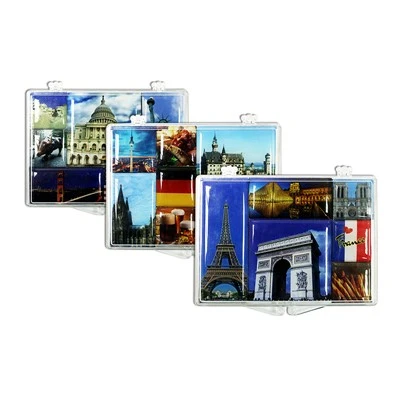
If you’ve ever stood in a gift shop at a museum, a historic landmark, or even a small town’s main street, you’ve probably stopped at the table stacked with square, round, and irregularly shaped souvenir magnets. Most people pick one up because it’s colorful, it reminds them of a fun trip, or it looks cool on their fridge. But as a souvenir magnet supplier who’s been in this business for over a decade, I can tell you that a lot of these magnets are more than just decorative trinkets—many are tiny, portable markers of real historical events. Not every magnet falls into this category, but for the ones that do, they tell a story that’s way more interesting than just a photo of a landmark. Souvenir Magnet

Let me start with a story that changed how I look at my own products. A few years back, a regular client came to me with a request: make a limited run of magnets for the centennial of the 19th Amendment, which gave women in the U.S. the right to vote. At first, I thought it’d be simple—just print a picture of the amendment’s text on a magnet and call it a day. But when I started digging, I found that the request was for a specific part of the amendment’s history, not just the text itself. The client, a local historical society, wanted magnets that featured the suffrage parade of 1913, the one that ended with a huge clash between protesters and police in Washington D.C. That event, not just the amendment’s passage, was what galvanized public support for the cause.
We worked with the society’s archivists to get a high-quality photo of that parade, cleaned it up, and made sure every detail was accurate: the women’s sashes, the signs that read “Votes for Women,” the crowd lining the streets. We even added a small line of text on the edge: “1913 Suffrage Parade – A Turning Point.” When the magnets went on sale, they sold out in three days. That’s when it hit me: souvenir magnets don’t just remind people where they’ve been—they can teach them something, too. A family from Ohio told me they’d bought the magnet and had a conversation with their kids about why women fought for the right to vote, something they wouldn’t have talked about if they’d just seen a standard statue magnet.
Now, not all historical event magnets are tied to big, national milestones. Some are tied to local stories that people in a specific town care deeply about. Last year, a small town in New England asked me to make magnets for the 200th anniversary of a local mill strike. The mill was the town’s main employer for decades, and the strike of 1824 was the first time workers in that area organized to demand better pay and safer conditions. The town didn’t have a big museum exhibit planned—just a small parade and a few local events—but the magnets became a way for residents to carry that history with them. We printed a drawing of the original mill, a sign that read “Mill Strike 1824: Workers’ First Stand,” and the date of the anniversary. A lot of local people bought them, and some even took them to work to show their colleagues. I’ve heard from other suppliers that this isn’t unique to my business—many small, community-focused magnets are made to honor these kinds of under-the-radar historical events that don’t make national news.
But here’s the thing: not every magnet labeled “historical” is actually based on a real event. That’s a line I’ve always been careful not to cross. I’ve seen other suppliers put out magnets that show “colonial life” or “old west scenes” that are just romanticized versions of history, not actual events. As someone who’s worked with local historians and historical societies for years, I know that people don’t buy these magnets just to have a souvenir—they want something that’s accurate. For example, when we made magnets for the 75th anniversary of D-Day, we didn’t just print a photo of a soldier on a beach. We worked with a veteran’s group to make sure the image was of a real soldier, from a real unit, who’d served at Normandy. We added the unit number and the date of the landing. Those magnets weren’t just popular with tourists—they were bought by veterans’ families across the country, who wanted a piece of that history to pass down.
Another example I love is the magnets we made for the 1969 moon landing. Most moon landing magnets just show the moon or the Apollo 11 capsule, but we worked with a space museum to create a series of magnets that focused on the small, human moments of that event. One magnet had a photo of Neil Armstrong taking his first step, with a line that read: “That’s one small step for man, one giant leap for mankind.” Another had a photo of the control room at NASA, with the mission’s team around a screen. We even made a few with a small piece of foil from the original capsule, pressed into the magnet’s base (though I have to note that those are rare, because we can’t get enough of those original pieces to make a lot of them). That moon landing magnet line is still one of our best-sellers, especially around July every year.
I also want to talk about a common misconception: that historical event magnets have to be from a long time ago. A lot of people assume “history” means something from 50 or 100 years back, but in reality, any event that shaped a community, a country, or even the world counts. In 2020, a city in the Midwest asked me to make magnets for the first anniversary of the local civil rights march that happened in 2019. The march was small, only a few hundred people, but it led to a change in the city’s police department policies. The client wanted magnets that honored the people who organized the march, and the progress that came from it. We printed a photo of the march, with the names of two local organizers, and the date of the march. When the magnets were sold at the city’s annual fair, a lot of young people bought them, and some even wore them on hoodies. That’s the beauty of historical event magnets: they can celebrate events that matter right now, not just the ones that are taught in textbooks.
Of course, there are challenges to making these kinds of magnets. The biggest one is accuracy. I’ve had a client come to me with a design that had a date wrong, or a photo that was mislabeled, and I’ve had to push back. It’s not worth it to put out a magnet that spreads misinformation, even if it’s for a big anniversary. We always work with local historians, archivists, or historical societies to double-check every detail: dates, names, photos, and the story behind the event. Another challenge is making the design stand out without being too cluttered. A magnet is small—usually around 3 inches wide—so we have to make sure the text and image are big enough to read, but not so busy that they lose the story. We also have to make sure the magnets are durable, because people stick them on their fridges, their car doors, their lockers—places where they’ll be bumped around a lot.
I’ve been doing this long enough to see how these small magnets can make a big difference. A few years ago, I got an email from a woman who’d bought one of our suffrage parade magnets. She said she’d grown up in a home where women’s rights were never talked about, but after seeing the magnet on her fridge every day, she’d started reading about the suffrage movement. She even joined a local chapter of a women’s advocacy group. That’s not the reaction I expected when I first started making these magnets. I thought they’d just be a way to make a little extra money, but they’ve become a way to share history with people who might not seek it out otherwise.
Another story that sticks with me is about a man who bought our mill strike magnet. He was a recent transplant to the small town, and he told me he’d moved there for a job, but didn’t know anything about the town’s history. The magnet made him go to the local library, where he found old newspaper articles about the strike. Now, he volunteers at the town’s historical society, helping to organize exhibits. That’s the kind of impact these small, 3-inch magnets can have. They’re not just decorations—they’re conversation starters, gateways to history.
If you’re someone who’s ever looked at a souvenir magnet and thought it’s just a cheap trinket, I hope this changes your mind. The best historical event magnets are the ones that come with a story. They’re the ones that make you stop, look closer, and ask: “Wait, what’s this about?” As a supplier, I’m proud to make these. I work with designers, historians, and community groups to make sure each magnet is accurate, respectful, and tells a true story.
If you’re interested in creating custom souvenir magnets that honor a historical event, whether it’s a local community milestone, a national anniversary, or something specific to your organization, reach out to our team to discuss your project. We can work with you to turn your vision into a durable, high-quality magnet that tells the story you want to share.
Radiation Protective Materials References
- National Women’s History Museum. (2023). The 1913 Woman Suffrage Parade: A Turning Point in the Fight for Voting Rights.
- Massachusetts Historical Society. (2022). The 1824 Lowell Mill Strike: Labor Activism in Early Industrial America.
- National WWII Museum. (2021). D-Day: The Invasion of Normandy, 1944.
- NASA. (2019). Apollo 11: The First Moon Landing.
- Local Historical Society of [Redacted City]. (2020). 2019 Civil Rights March: A Local Story of Progress.
Shenzhen Magplus Technology Co., Ltd.
As one of the most professional souvenir magnet manufacturers and suppliers in China, we’re featured by quality products and good service. Please rest assured to wholesale customized souvenir magnet made in China here from our factory. Also, free sample is available.
Address: Room 602, Rujun Building, No.105 Zhongxing Rd, Bantian Street, Shenzhen, China.
E-mail: Iris.huang@newlife.cn
WebSite: https://www.newlifemagplus.com/
